
WHY THIS MATTERS TO YOU AS A C-LEVEL EXECUTIVE
You’ve likely sensed it during high-stakes board meetings: some executives read the room differently. They anticipate market shifts others miss. They navigate organizational complexity with unusual fluidity. They pace strategic initiatives with an almost rhythmic precision.
What if these aren’t just personality traits or lucky intuitions? What if they’re learnable cognitive capabilities—and you’ve been missing the training ground that develops them?
Here’s what’s in it for you: Access to a leadership development approach that traditional business schools cannot provide because they lack the foundational understanding of how artistic cognitive training enhances executive decision-making. This isn’t about attending another leadership offsite or reading another management book. This is about understanding—and potentially activating—cognitive advantages that could transform how you navigate the paradoxes you face daily.
The executives who will thrive in the next decade won’t be those with the best MBA credentials or the most strategy frameworks. They’ll be those who can process complexity faster, recognize patterns earlier, and orchestrate organizational change with the precision of a conductor leading a 90-piece orchestra through a demanding score.
My research investigates exactly this: how cognitive capabilities developed through classical music training might transfer directly to executive leadership effectiveness. And more importantly, whether these capabilities can be systematically developed in leaders who lack formal artistic training.
WHAT I’M BUILDING FOR YOU
A research-backed framework that enhances three critical executive capabilities:
Pattern Recognition: Spotting the weak signals in market noise before competitors do—like hearing a single instrument slightly off-key in a complex orchestral passage.
Structural Awareness: Understanding how changes in one part of your organization ripple through the entire system—the way a musician understands how melody, harmony, rhythm, and dynamics interact to create coherent performance.
Temporal Mastery: Pacing strategic initiatives across multiple time horizons simultaneously—balancing immediate market response with long-term transformation the way a performer balances technical precision with interpretive spontaneity.
These aren’t metaphors. These are measurable cognitive capabilities that my research is validating through systematic study of executives with musical backgrounds compared to those without.
HOW THIS BECOMES REAL FOR YOUR ORGANISATION
Having started in October 2025, my Executive PhD at Antwerp Management School will produce frameworks you can actually use—not theoretical models that gather dust on bookshelves. Through The Leadership Artist consultancy launching in parallel, these insights move immediately from research to practice in real organizations facing real complexity.
This means you get access to:
- Evidence-based methodologies validated through academic rigor
- Frameworks developed by someone who’s sat in your chair at companies like XING, Nokia, and DERTOUR Group
- Approaches that integrate artistic cognitive principles with proven strategic consulting methodologies
- Development programs that enhance decision-making capabilities rather than just teaching new frameworks
The traditional choice has been consultants with no research foundation or academics with no executive experience. You shouldn’t have to choose. You should have both.
THE PARADOX OF THE C-SUITE
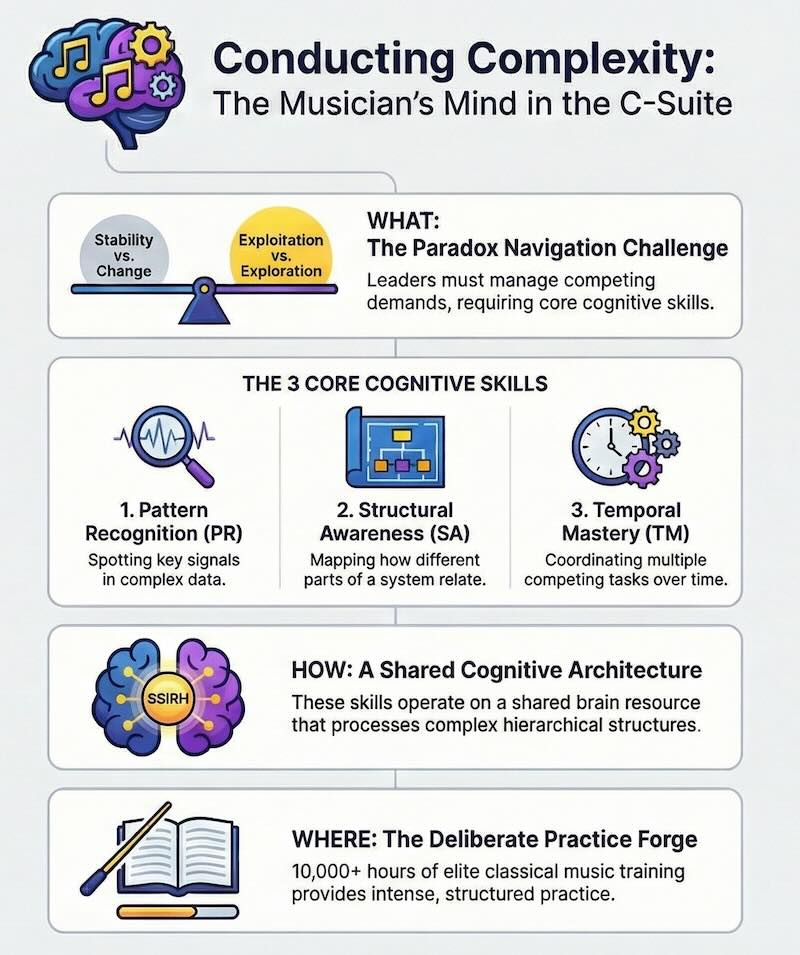
In my tenure as a Chief Product Officer and digital transformation leader, I discovered that leadership is rarely about choosing between “right” and “wrong.” Instead, it’s about navigating paradoxes: balancing stability with radical change, or exploiting current assets while exploring new frontiers. This “Paradox Navigation Challenge” requires a cognitive architecture that many traditional leadership development programs struggle to define, let alone cultivate.
As the diagram shows, three core cognitive skills emerge from the “deliberate practice forge” of elite musical training:
Pattern Recognition (PR): The ability to spot key signals within complex, noisy data—much like a conductor hearing a single flat note in a 90-piece orchestra.
Structural Awareness (SA): Understanding how different parts of a system relate to the whole, essential for navigating the hierarchical structures of global corporations.
Temporal Mastery (TM): The rhythmic coordination of multiple competing tasks over time, which is the essence of strategic pacing in strategic consulting and business environments.
BRIDGING TWO WORLDS: MY RESEARCH APPROACH
To the academic community, the value I bring is rooted in my research approach—a scholarly term for how we decide what constitutes valid knowledge and reliable evidence.
In many academic circles, research is conducted from the “outside in,” observing executives as subjects. My research adopts a practitioner-scholar perspective, which might be described as “inside out.” I believe that the most profound insights into strategic thinking for executives come from a place of lived experience. Because I’ve sat in the chair, I don’t just ask if a leadership theory works; I ask how it survives the friction of a board meeting or a failing digital transformation project.
This stance enhances research quality by ensuring that the variables we study are actually relevant to those in the field. When I investigate how musical intelligence might enhance business decision-making, I’m not looking for poetic metaphors. I’m looking for the shared cognitive architecture—essentially, the mental systems that allow a leader to process complex, multi-layered information more effectively.
Traditional consultants often lack research foundations to prove their methods work. For instance, many leadership programs claim to enhance “strategic thinking” without defining what that means cognitively or measuring whether it actually improves outcomes. Pure academics, meanwhile, might study decision-making in controlled environments that bear little resemblance to a CEO facing a board revolt during a platform migration.
WHY THE PRACTITIONER-SCHOLAR MATTERS
The goal of this PhD is not just to add another degree to my wall, but to develop research-backed leadership development methodologies built on demonstrable foundations. Traditional consultants often lack the research rigor to validate their methods, while pure academics often lack the C-level experience to understand why they might fail in practice.
By combining 20+ years of digital leadership with the rigor of Antwerp Management School, I am working to address an important gap in how we understand executive leadership. We are moving beyond “gut feeling” leadership toward a model where artistic intelligence, executive experience, and academic evidence converge.
Balancing rigorous methodology with practical relevance isn’t easy—academia values theoretical contribution while executives need frameworks they can apply Monday morning. My conviction is that the tension between these worlds is precisely where breakthrough insights emerge.
This journey is about more than personal growth; it is about creating a new market category for executive leadership services where the practitioner’s perspective transforms the scholar’s precision into something genuinely useful for leaders navigating complexity.
THE RESEARCH IN PRACTICE
My research methodology is evolving, but one principle is clear: it must be as credible in peer-reviewed journals as it is useful in executive boardrooms. That means mixed-method research, cognitive analysis, and an eye toward actionable frameworks.
Having started in October 2025 at Antwerp Management School, my Executive PhD will bridge these two domains—academia and leadership—in an unprecedented way. And it won’t stay locked in theory. My parallel venture, The Leadership Artist, launches to put insights into practice in real organisations.
This research isn’t about comparing symphonies to org charts. It goes far beyond metaphor. I’m building a scientifically rigorous framework to explore how the brain processes honed through artistic mastery—like anticipatory thinking, structured improvisation, and emotional pattern recognition—can transfer into complex business leadership.
Academics across Europe immediately saw the relevance. In VUCA (volatile, uncertain, complex, ambiguous) environments, traditional leadership models often fall short. Artists, however, are trained to navigate uncertainty, ambiguity, and creative constraints every day. And yet, empirical studies exploring this link remain rare.
That’s where I come in. With a background that combines classical guitar performance, choir conducting, a Management of Cultural Affairs degree, and an Executive MBA from HEC Paris—with decades in senior executive roles—I’ve lived both worlds. Now, through doctoral research, I’m systematically investigating what many of us have sensed intuitively for years.
My research methodology combines quantitative assessments of cognitive capabilities with qualitative case studies of executives with musical backgrounds. Early findings suggest significant advantages in strategic pattern recognition and decision-making effectiveness among leaders with classical music training.
THE PATH FORWARD: FROM THEORY TO PRACTICE
As I continue this research journey at Antwerp Management School, my aim extends beyond producing another academic thesis. I’m creating frameworks that business schools can integrate into executive education while developing consulting methodologies that organizations can immediately apply.
This dual standard—academic rigor meeting executive relevance—defines what it means to be a practitioner-scholar in the field of strategic leadership. The Leadership Artist consultancy serves as the testing ground, the living laboratory where research meets reality.
If you’re an executive who’s sensed that your musical training, artistic background, or creative practice gives you cognitive advantages your peers lack—but couldn’t articulate why—I’d value your perspective as a potential research participant. And if you’re facing strategic complexity that traditional leadership frameworks don’t address, let’s explore whether artistic intelligence offers the missing piece your organization needs.
The intersection of research and real-world impact is where genuine innovation happens. This is only the beginning.