
“The best leadership school I ever attended wasn’t a business school. It was the music conservatory—though I didn’t realize it at the time.”
During a particularly complex market research analysis, I wasn’t relying on frameworks or case studies. I was reading the chaos like a Bach fugue—identifying patterns, anticipating developments, and sensing the underlying structure others couldn’t see. The breakthrough didn’t come from my MBA training. It came from years of classical guitar performance.
This wasn’t coincidence.
It was cognitive transfer in action.
The Unassailable Credibility Triangle
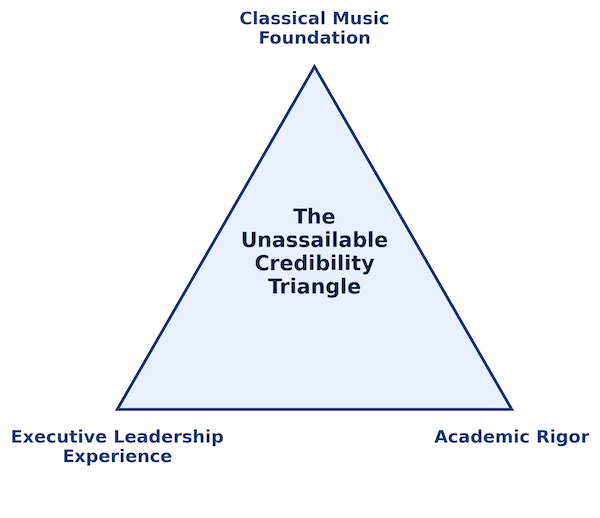
My Classical Music Foundation as a Guitarist and Choir Conductor — Conservatory training in pattern recognition, temporal mastery, and interpretative precision
My Lived Executive Leadership Reality — 20+ years navigating C-level complexity at major technology companies (XING, Nokia, REWE Group)
My Planned Academic Rigor — Three Master’s degrees plus Executive PhD research starting October 2025 at Antwerp Management School
“Find another consultant-researcher with decades of executive experience and this exact combination.”
“Leadership research rarely combines the conservatory, the boardroom, and the doctoral lab — my career had to do all three.”
The Fascinating Gap
“Executives are trained to think in frameworks. Musicians are trained to think in patterns.”
Classical musicians routinely demonstrate capabilities that executives desperately need:
- Real-time pattern recognition in complex, changing environments
- Temporal mastery managing multiple simultaneous layers
- Interpretative precision turning abstract ideas into compelling execution
- Performance under pressure with authentic presence
Leadership development programs, by contrast, keep focusing on rational frameworks rather than artistic intelligence.
“Leadership isn’t short of frameworks. It’s short of cognitive enhancement.”
The Academic Investigation
Starting October 2025, my Executive PhD research will systematically investigate these cognitive transfer mechanisms. This isn’t theoretical speculation—it’s the first empirical study examining how classical music training specifically enhances strategic decision-making effectiveness in digital business environments.
Research questions that fascinate me:
- How does musical pattern recognition transfer to strategic sense-making?
- Can temporal mastery from performance enhance strategic timing?
- What cognitive processes link artistic interpretation to executive presence?
Beyond Metaphor
Most arts-leadership connections remain metaphorical: “leadership is like conducting an orchestra.” Interesting, but not actionable.
I’m investigating something more precise: measurable cognitive capabilities developed through musical training that directly enhance strategic leadership effectiveness.
This research sits at the intersection of organizational psychology, cognitive science, and management practice—a territory few can navigate because it requires lived experience in all three domains.
The Practitioner-Scholar Advantage
Rather than studying leadership from the outside, I’m investigating patterns I unconsciously applied throughout my executive career. That’s the practitioner-scholar advantage.
“I’m not studying leadership from the outside — I’ve lived it, and now I’m decoding it.”
It creates unique research opportunities:
- Insider access to C-level decision-making processes
- Lived validation of theoretical frameworks
- Real-world testing of cognitive enhancement approaches
- Peer credibility with research participants
The Broader Implications
If these connections prove systematic and teachable, the implications extend far beyond individual executive development:
For business education: Why Business Schools Are Missing the Point For executive development: Evidence-based approaches to cognitive enhancement For organizational effectiveness: The Practitioner-Scholar Advantage: Why Lived Experience Matters For interdisciplinary research: Research That Goes Beyond Metaphor
This is also the foundation of my consultancy: helping executives strengthen strategic capabilities through the cognitive power of artistic intelligence.
The Journey Ahead
This investigation is just beginning. Over the coming years, I’ll share research discoveries, methodological insights, and early findings from this unprecedented exploration.
Whether you’re an executive curious about cognitive enhancement, an academic interested in interdisciplinary research, a business educator exploring curriculum innovation, or simply fascinated by the intersection of artistic training and strategic thinking—I invite you to follow along.
The questions we’re exploring matter for anyone navigating complexity in leadership, creativity, or strategic decision-making.
What's Your Experience?
Have you noticed artistic training influencing your professional capabilities? What cognitive skills from creative disciplines enhance your strategic thinking? Where do you see arts-leadership connections that deserve systematic investigation?
This is the conversation I’m building my consultancy around—and I’d love for you to be part of it.
Following my research journey? Connect with me as I document this exploration of artistic intelligence in executive leadership.