
💼 Consultancy

When you’re pioneering something that doesn’t quite exist yet, how do you make it visible? This is the story of how I built The Leadership Artist brand from scratch—and what I learned about strategic thinking for executives in the process.

The Challenge: Positioning the Impossible for Executive Leadership

After 20+ years in executive leadership roles at companies like XING, Nokia, and DERTOUR Group, I faced an unusual branding challenge. How do you visually represent the intersection of classical music training and executive leadership? How do you make something as abstract as “cognitive transfer from artistic practice to strategic thinking for executives” immediately understandable?

Most consultants play it safe—clean corporate blues, generic sans-serif fonts, stock photos of handshakes. But safe wasn’t going to work for what I was building.

The Strategic Foundation: Why Visual Thinking Matters in Strategic Consulting

Before touching any design tools, I spent weeks thinking like a strategist:

Target Audience Analysis:

  • Busy C-suite executives seeking executive coaching (primary)
  • Academic researchers studying evidence-based leadership (secondary)
  • Both groups value substance over style, but first impressions matter enormously

Market Positioning:

  • Not just another “creativity consultant”
  • Not an academic who’s never run a P&L
  • Unique intersection: proven executive leadership + formal artistic training + research-backed leadership development

Brand Promise: Evidence-based leadership frameworks that bridge artistic cognitive processes with strategic consulting capabilities.

The Design Process: Making Abstract Leadership Development Ideas Concrete

1. The Logo: A Literal Bridge

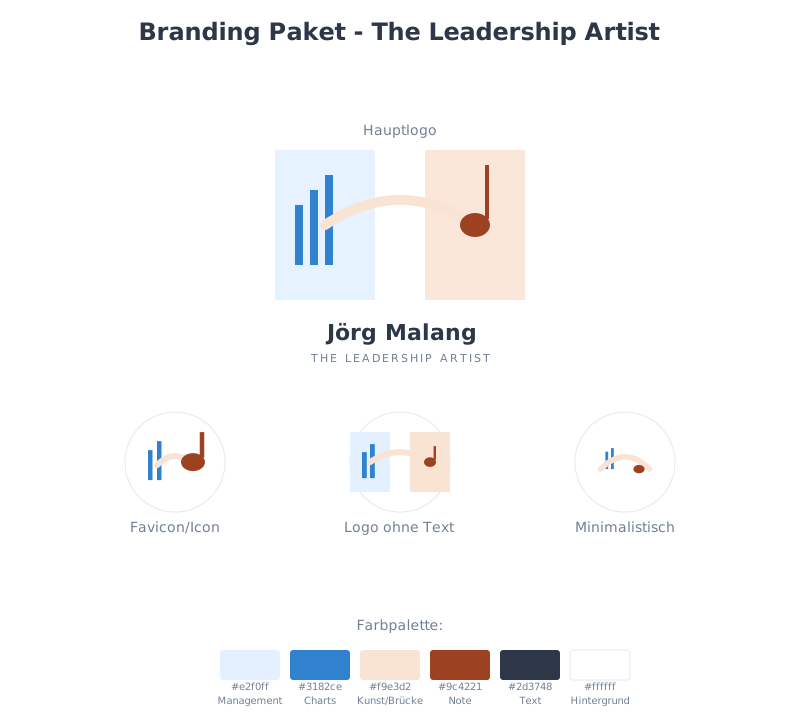
The breakthrough came when I stopped trying to be clever and embraced the obvious metaphor. Management on one side, Art on the other, connected by an actual bridge.

  • Management side: Clean data visualisation bars (analytics, metrics, KPIs)
  • Art side: Musical note (performance, creativity, interpretation)
  • The Bridge: The transformative process itself

Simple. Immediate. Memorable.

2. Colour Psychology for Executives

Every colour choice was strategic for executive presence training:

  • Primary Dark Blue (#1a365d): Trust, authority, C-suite credibility
  • Secondary Blue (#3182ce): Innovation, digital transformation
  • Artistic Brown (#9c4221): Warmth, authenticity, classical tradition
  • Bridge Cream (#f9e3d2): Connection, accessibility, warmth

The palette had to feel equally at home in a boardroom and a concert hall.

Strategic Decisions: What Not to Do in Executive Leadership Branding

Avoided the “Creative Consultant” Trap:

  • No rainbow colours or whimsical fonts
  • No stock photos of lightbulbs or people jumping
  • No abstract art that executives can’t decode quickly

Avoided the “Academic” Stereotype:

  • No overly formal, institutional look
  • No dense text blocks or academic jargon
  • No imagery that screams “theory over practice”

The Illustrations: Showing Creative Leadership Strategies in Action

Perhaps the most challenging aspect was creating illustrations that made creative leadership strategies concrete:

“Musical Leadership” Scene: A conductor leading an orchestra, but the musicians are business figures—immediately shows “executive leadership through artistic principles”

“The Bridge” Diagram: Visual representation of the cognitive transfer process, making strategic thinking for executives tangible

“Orchestration of Excellence”: Shows how individual business functions work together like sections of an orchestra

Each illustration had to convey the concept quickly and clearly—would a busy executive immediately understand what I was proposing?

Lessons for Strategic Leaders

Building this brand taught me several things that apply beyond visual design:

1. Clarity Beats Cleverness

The most effective solution was the most obvious one. Sometimes we overcomplicate complex leadership challenges when the straightforward approach works best.

2. Speak Your Audience’s Visual Language

After decades in executive leadership roles, I’ve seen countless presentations, brands, and designs that simply don’t connect with senior leadership. Every design choice had to speak “executive”—clean, purposeful, results-oriented—while still honoring the artistic foundation.

3. Authenticity Creates Differentiation

I could have hired an agency to create something more polished. But building it myself ensured every element genuinely reflected my strategic consulting vision and capabilities.

The Launch: From Brand to Strategic Consulting Practice

Three months later, as I prepare to officially launch The Leadership Artist, I’m excited about what the brand represents. My ambitions for what it should achieve:

  • Immediate Recognition: Helping people remember “the music and management approach”
  • Credibility Building: The professional look should get me taken seriously for executive coaching
  • Conversation Starter: The unusual positioning should create curiosity about evidence-based leadership
  • Authentic Representation: It should genuinely reflect what I offer in research-backed leadership development

Whether these ambitions are justified—that’s for the market to decide. Early feedback has been encouraging, with several conversations already showing genuine interest in the concept. But the real test begins now.

What’s Next: From Brand to Practice

A strong brand is just the foundation. Now comes the real work—delivering on the promise, conducting the research, building the frameworks that will transform how leaders think about strategic thinking for executives.

The Leadership Artist gives me a platform to start meaningful conversations, but the value will ultimately be proven through strategic consulting results and executive coaching effectiveness.


Building something new requires making the invisible visible. Whether you’re developing a disruptive strategy, leading a digital transformation, or pioneering a new market category, the principles remain the same: know your audience, clarify your value, and make complex leadership challenges immediately understandable.

Curious how creative leadership strategies could transform your executive leadership presence? Let’s explore how artistic principles might enhance your strategic consulting capabilities.

At 57, I Finally Understood Why I Think Differently: From HEC Paris Executive MBA to PhD Research

In spring 2025, a colleague asked me a simple question: “Why aren’t you using your musical skills to improve your leadership?” I smiled politely, but the question haunted me. He was right. I had been using my musical training for years—just not consciously. The way I spotted patterns before they emerged in data. My instinctive sense of timing in transformation initiatives. The ability to understand the “architecture” behind complex problems. These weren’t personality quirks. They were cognitive habits shaped through decades of classical guitar training, long before my executive career began. That offhand question opened a door I hadn’t realized was there—and set me on the path from the HEC Paris Executive MBA to doctoral research at 57.

No More Masks in Business

I’ve made a radical decision: no more masks in business.

The corporate world taught me to suppress feelings, harmonize instead of speaking truth, and prioritize data over intuition. But this false professionalism costs companies millions in missed opportunities and demotivated teams.

My breakthrough came through coaching and my lifelong passion for classical music. Like a conductor sensing the finest nuances in an orchestra, sensitive leaders feel the harmonies and dissonances in their teams. This artistic sensitivity isn’t weakness—it’s a competitive advantage.

Authenticity means trusting your feelings as precise sensors, bringing uncomfortable truths to the table, and giving emotions the space they deserve in decision-making. It’s the foundation for my consultancy “Leadership Artist” and my upcoming doctoral research.

I’m done pretending. Authenticity is my new superpower, and it will transform how I lead forever.

Strategic Thinking for Executives: The Intentional 30-Year Leadership Development Journey

Thirty years. That’s the time required to build something truly distinctive in executive leadership development.
Most consultants rely on frameworks drawn from textbooks or business school case studies. My approach is different: cognitive capabilities developed through systematic preparation across three disciplines—classical music performance, cultural management, and C-level digital leadership.
This was not accidental. It was intentional preparation for a methodology that delivers strategic clarity in complex environments.
From interpreting orchestral scores at Cologne’s University of Music to navigating digital transformation at XING and Nokia, discover how pattern recognition and structural awareness transfer from artistic training to executive decision-making effectiveness.

Three Master’s Degrees Later: Strategic Thinking Development from Classical Guitarist to Chief Product Officer

When colleagues ask about my path from classical guitarist to C-level executive, they see contradiction. I see deliberate preparation.
Classical music training develops pattern recognition capabilities most executives never access—simultaneous analysis of harmonic structure, temporal relationships, and interpretative decisions under pressure. These cognitive frameworks proved essential when analysing market dynamics at XING, Nokia, and DERTOUR Group.
My three master’s degrees weren’t random achievements. Music Pedagogy provided cognitive frameworks, Cultural Management bridged creative and analytical thinking, Executive MBA offered systematic business application.
Now, through my Executive PhD at Antwerp Management School, I’m systematically investigating what I’ve applied intuitively for two decades: how musical training enhances executive strategic thinking.
Read the full story of how intentional preparation created the foundation for Leadership Artist—where academic validation meets executive practice.

Research-Backed Leadership Development: The Overlooked Cognitive Dimension I’m Built to Explore

After two decades in management teams at XING, Nokia, and DERTOUR Group, I’ve seen leadership frameworks come and go—each promising transformation, few addressing what actually determines strategic performance in modern organisations.

Leadership development suffers from a structural blind spot: it focuses on behaviours and tools, while the real differentiator lies in how leaders process complexity.

This gap exists because neither academia nor consultancy systematically investigates the cognitive capabilities that enable exceptional strategic thinking—pattern recognition, temporal anticipation, interpretative discipline.

What if these capabilities could be trained through formal artistic methods? Not as metaphor, but as structured cognitive development?

This is the question at the heart of The Leadership Artist: exploring whether conservatory-level musical training can measurably enhance strategic leadership effectiveness. My PhD research, begun in October 2025 at Antwerp Management School, aims to establish the empirical foundation.

Evidence-Based Leadership: Why Only a Former Executive Can Solve Executive Problems

When Peer Credibility Transforms Executive Consulting
Most consultants advising C-level executives have never occupied those chairs themselves. They’ve studied leadership but haven’t lived the weight of decisions affecting thousands of employees and millions in revenue.
After 20 years in C-Level roles at XING, Nokia, DERTOUR Group, and others, I transitioned into research-backed consultancy. That sequence matters profoundly. Executives need more than frameworks and case studies—they need advisors who’ve navigated comparable complexity, recognize unspoken pressures, and permit the honest conversations that transform strategic decision-making.
For challenges that truly matter, peer credibility changes everything.

Bridging the Gap: Why Science-Backed Leadership is the New Executive Mandate

Why settle for anecdotal leadership advice? Bridge the gap between boardroom reality and academic rigor with evidence-based strategies. As a practitioner-scholar with 20+ years of C-level experience , I apply a post-positivist lens to identify the objective, measurable mechanisms that might enhance executive effectiveness

From Executive Suite to Leadership Artist: Launching Research-Driven Executive Leadership Consulting

The Leadership Artist launches this November—a research-driven consultancy where academic insights meet business practice. Born from my Executive PhD research into how musical training enhances strategic leadership, it’s designed as a living lab where theory and practice inform each other. I didn’t want to wait four years to make an impact…

Welcome to Academia: Where Research Meets Real-World Leadership

After more than 20 years leading digital transformation at companies like XING, Nokia, and DERTOUR Group, I’ve made an unusual career pivot. This October, I’m embarking on an Executive PhD journey at Antwerp Management School, investigating how cognitive processes developed through classical music training transfer to strategic decision-making in complex business environments. This category documents the intersection of rigorous academic research with practical leadership experience, offering insights from someone who has actually navigated boardrooms and digital transformations while applying artistic cognitive frameworks to real strategic challenges.

2025 in Review: Why This Year Redefined My Approach to Leadership

You’re navigating complexity that traditional leadership training never prepared you for. Pattern recognition across ambiguity. Temporal mastery under pressure. Authentic presence in critical moments. Business schools don’t systematically build these capabilities.

For 20 years, I unconsciously applied cognitive frameworks from classical music to C-level challenges—and it worked. Customer data analysis that revealed patterns conventional methods missed. Board presentations demanding full sensory presence and real-time adaptation. Strategic decisions requiring temporal control across multiple time horizons.

In 2025, I realized what I’d been doing: running a two-decade field experiment in cognitive transfer that academia hasn’t explored and consulting firms can’t replicate.

This article explains how that unconscious practice becomes systematic methodology. Why I launched The Leadership Artist alongside Executive PhD research. And what 2026 represents when three decades of preparation—conservatory training, cultural management, Executive MBA, C-level experience, doctoral research—converge into evidence-based frameworks for strategic thinking you can actually use.