
When you’re pioneering something that doesn’t quite exist yet, how do you make it visible? This is the story of how I built The Leadership Artist brand from scratch—and what I learned about strategic thinking for executives in the process.
The Challenge: Positioning the Impossible for Executive Leadership
After 20+ years in executive leadership roles at companies like XING, Nokia, and DERTOUR Group, I faced an unusual branding challenge. How do you visually represent the intersection of classical music training and executive leadership? How do you make something as abstract as “cognitive transfer from artistic practice to strategic thinking for executives” immediately understandable?
Most consultants play it safe—clean corporate blues, generic sans-serif fonts, stock photos of handshakes. But safe wasn’t going to work for what I was building.
The Strategic Foundation: Why Visual Thinking Matters in Strategic Consulting
Before touching any design tools, I spent weeks thinking like a strategist:
Target Audience Analysis:
- Busy C-suite executives seeking executive coaching (primary)
- Academic researchers studying evidence-based leadership (secondary)
- Both groups value substance over style, but first impressions matter enormously
Market Positioning:
- Not just another “creativity consultant”
- Not an academic who’s never run a P&L
- Unique intersection: proven executive leadership + formal artistic training + research-backed leadership development
Brand Promise: Evidence-based leadership frameworks that bridge artistic cognitive processes with strategic consulting capabilities.
The Design Process: Making Abstract Leadership Development Ideas Concrete
1. The Logo: A Literal Bridge
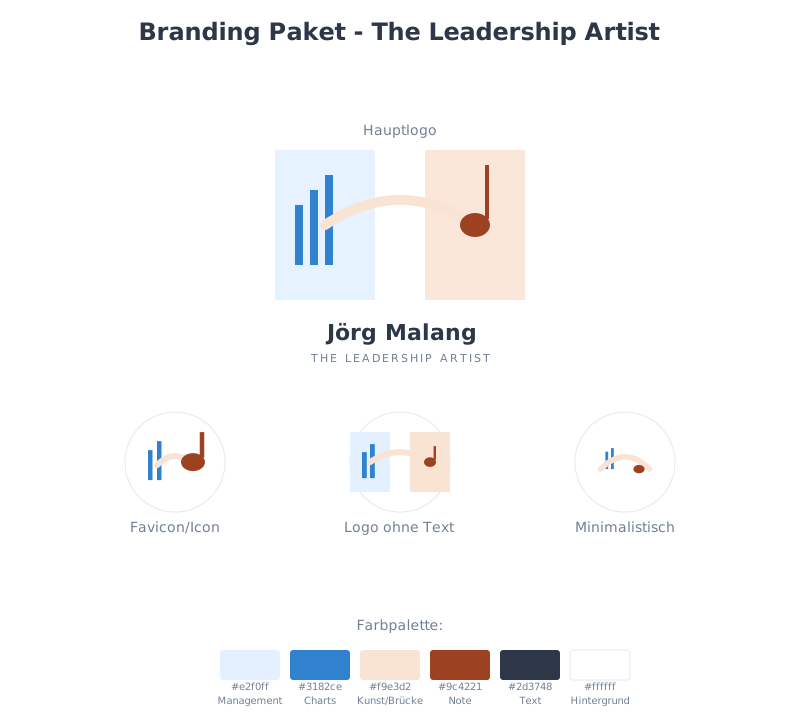
The breakthrough came when I stopped trying to be clever and embraced the obvious metaphor. Management on one side, Art on the other, connected by an actual bridge.
- Management side: Clean data visualisation bars (analytics, metrics, KPIs)
- Art side: Musical note (performance, creativity, interpretation)
- The Bridge: The transformative process itself
Simple. Immediate. Memorable.
2. Colour Psychology for Executives
Every colour choice was strategic for executive presence training:
- Primary Dark Blue (#1a365d): Trust, authority, C-suite credibility
- Secondary Blue (#3182ce): Innovation, digital transformation
- Artistic Brown (#9c4221): Warmth, authenticity, classical tradition
- Bridge Cream (#f9e3d2): Connection, accessibility, warmth
The palette had to feel equally at home in a boardroom and a concert hall.
Strategic Decisions: What Not to Do in Executive Leadership Branding
Avoided the “Creative Consultant” Trap:
- No rainbow colours or whimsical fonts
- No stock photos of lightbulbs or people jumping
- No abstract art that executives can’t decode quickly
Avoided the “Academic” Stereotype:
- No overly formal, institutional look
- No dense text blocks or academic jargon
- No imagery that screams “theory over practice”
The Illustrations: Showing Creative Leadership Strategies in Action
Perhaps the most challenging aspect was creating illustrations that made creative leadership strategies concrete:
“Musical Leadership” Scene: A conductor leading an orchestra, but the musicians are business figures—immediately shows “executive leadership through artistic principles”
“The Bridge” Diagram: Visual representation of the cognitive transfer process, making strategic thinking for executives tangible
“Orchestration of Excellence”: Shows how individual business functions work together like sections of an orchestra
Each illustration had to convey the concept quickly and clearly—would a busy executive immediately understand what I was proposing?
Lessons for Strategic Leaders
Building this brand taught me several things that apply beyond visual design:
1. Clarity Beats Cleverness
The most effective solution was the most obvious one. Sometimes we overcomplicate complex leadership challenges when the straightforward approach works best.
2. Speak Your Audience’s Visual Language
After decades in executive leadership roles, I’ve seen countless presentations, brands, and designs that simply don’t connect with senior leadership. Every design choice had to speak “executive”—clean, purposeful, results-oriented—while still honoring the artistic foundation.
3. Authenticity Creates Differentiation
I could have hired an agency to create something more polished. But building it myself ensured every element genuinely reflected my strategic consulting vision and capabilities.
The Launch: From Brand to Strategic Consulting Practice
Three months later, as I prepare to officially launch The Leadership Artist, I’m excited about what the brand represents. My ambitions for what it should achieve:
- Immediate Recognition: Helping people remember “the music and management approach”
- Credibility Building: The professional look should get me taken seriously for executive coaching
- Conversation Starter: The unusual positioning should create curiosity about evidence-based leadership
- Authentic Representation: It should genuinely reflect what I offer in research-backed leadership development
Whether these ambitions are justified—that’s for the market to decide. Early feedback has been encouraging, with several conversations already showing genuine interest in the concept. But the real test begins now.
What’s Next: From Brand to Practice
A strong brand is just the foundation. Now comes the real work—delivering on the promise, conducting the research, building the frameworks that will transform how leaders think about strategic thinking for executives.
The Leadership Artist gives me a platform to start meaningful conversations, but the value will ultimately be proven through strategic consulting results and executive coaching effectiveness.
Building something new requires making the invisible visible. Whether you’re developing a disruptive strategy, leading a digital transformation, or pioneering a new market category, the principles remain the same: know your audience, clarify your value, and make complex leadership challenges immediately understandable.
Curious how creative leadership strategies could transform your executive leadership presence? Let’s explore how artistic principles might enhance your strategic consulting capabilities.